AWS HPC Blog
Tag: simulations
How Aionics accelerates chemical formulation and discovery with AWS Parallel Computing Service
This post was contributed by Mohamed K. Elshazly, PhD, Kareem Abdol-Hamid, Sam Bydlon, PhD, Aarabhi Achanta, and Mark Azadpour The decarbonization of our modern economy depends on solving a defining scientific challenge: developing batteries that are both safe and high performing. From electrical grids to vehicles and aviation, these energy storage devices must provide power […]
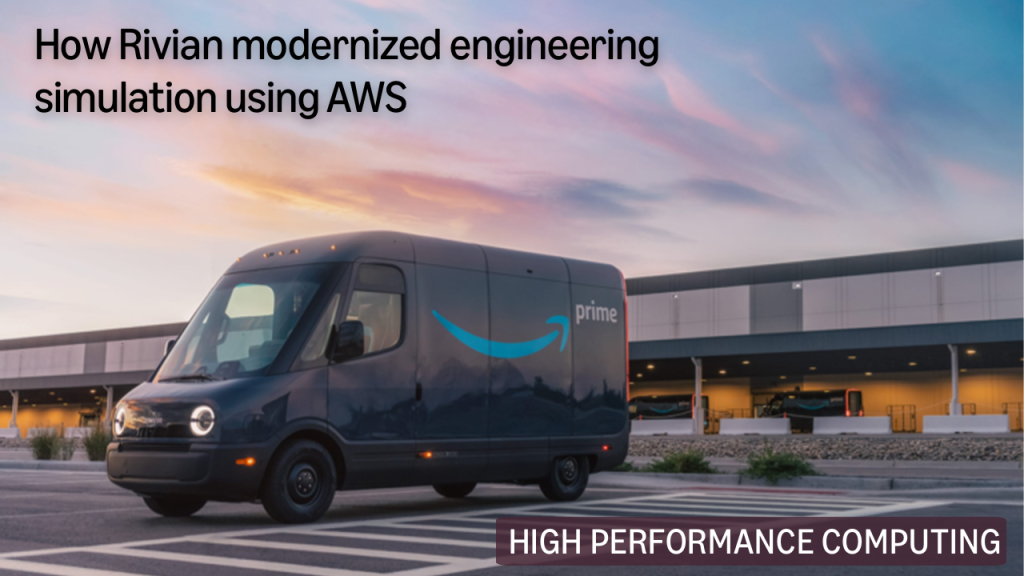
How Rivian modernized engineering simulation using AWS
This post was contributed by Ameya Kamerkar (Rivian), Vikram Pendyam (Rivian), Abhishek Chauhan (Rivian), Ajay Paknikar (AWS), Sandeep Sovani (AWS) Figure 1. Rivian’s custom Amazon Electric Delivery Vehicle (EDV) (Credits: Rivian media kit) In this post, we share how Rivian, a leading electric vehicle manufacturer, revolutionized their engineering simulation capabilities by migrating to AWS and […]
How Daiichi Sankyo modernized drug discovery using AWS Parallel Computing Service
This blog was co-authored by Takehiro Nakajima and Mark Azadpour from AWS and Rintaro Yamada, Rei Kajitani and Ryo Kunimoto from Daiichi Sankyo In recent years, the informatics field of drug discovery has seen a rapid increase in workloads requiring large-scale parallel computing, such as genome analysis, structure prediction, and drug design. Daiichi Sankyo has […]
Announcing expanded support for Custom Slurm Settings in AWS Parallel Computing Service
Today we’re excited to announce expanded support for custom Slurm settings in AWS Parallel Computing Service (PCS). With this launch, PCS now enables you to configure over 65 Slurm parameters. And for the first time, you can also apply custom settings to queue resources, giving you partition-specific control over scheduling behavior. This release responds directly […]
How DTN accelerates operational weather prediction using NVIDIA Earth-2 on AWS
Cyclone chasing just got a whole lot smarter! Check out how DTN’s AI-powered weather model is rewriting the forecast. Brace yourself for the future of weather prediction.

Leveraging LLMs as an Augmentation to Traditional Hyperparameter Tuning
When seeking to improve machine learning model performance, hyperparameter tuning is often the go-to recommendation. However, this approach faces significant limitations, particularly for complex models requiring extensive training times. In this post, we’ll explore a novel approach that combines gradient norm analysis with Large Language Model (LLM) guidance to intelligently redesign neural network architectures. This […]

How to migrate a VeriFire Emulator design from F1 to F2 Instances
Boost ASIC verification efficiency with SilverLining EDA’s VeriFire on Amazon EC2 F2 Instances: Unlock up to 60% better price-performance compared to F1, and accelerate your FPGA build times by 80% with SilverLining EDA’s cloud-based emulation solution.

AI-Enhanced Subsurface Infrastructure Mapping on AWS
Subsurface infrastructure mapping is crucial for industries ranging from oil and gas to environmental protection. Our groundbreaking approach combines advanced magnetic imaging with physics-informed AI to provide unparalleled visibility into hidden structures, even when traditional methods fall short. Explore how this fusion of cloud computing and AI is opening new possibilities for subsurface exploration and management.

Engineering at the speed of thought: Accelerating complex processes with multi-agent AI and Synera
In this post, we’ll examine how this multi-agent approach works, the architecture behind it, and the efficiency improvements it enables. While the focus is on an engineering use case, the principles apply broadly to any organization facing the challenge of coordinating specialized expertise to deliver faster, more consistent results.

Optimizing HPC workflows with automatically scaling clusters in Ansys Gateway powered by AWS
Ansys Gateway powered by AWS now has an integration with AWS ParallelCluster to enable users deploy on-demand HPC clusters for running Ansys simulations on AWS. This allows engineers to run large-scale simulations efficiently while optimizing cloud costs by dynamically adjusting resources based on simulation workload requirements. In this blog post, we describe the architecture, workflow, and Amazon EC2 recommendations for running Ansys applications in Ansys Gateway.