Containers
Category: Networking & Content Delivery
Using Amazon ECS with NVIDIA GPUs to accelerate drug discovery
This post was written in collaboration with Neel Patel, Drug Discovery Scientist, Nvidia. Drug discovery is the process through which potential new medicines are identified. It involves a wide range of scientific disciplines, including biology, chemistry, and pharmacology, as well as computer science. AstraZeneca and NVIDIA collaborated on developing MegaMolBART so the computational drug discovery process […]

Architecting for resiliency on AWS App Runner
AWS App Runner is one of the simplest ways to run your containerized web applications and APIs on AWS. App Runner abstracts away the cloud resources needed for running your web application or API, including load balancers, TLS certificates, auto-scaling, logs, metrics, tracing (such as observability), as well as the underlying compute resources. With App Runner, […]

Observability for AWS App Runner VPC networking
With AWS App Runner, you can quickly deploy web applications and APIs at any scale. You can start with your source code or a container image, and App Runner will fully manage all infrastructure, including servers, networking, and load balancing for your application. If you want, App Runner can also configure a deployment pipeline for […]

Three things to consider when implementing Mutual TLS with AWS App Mesh
NOTICE: October 04, 2024 – This post no longer reflects the best guidance for configuring a service mesh with Amazon ECS and Amazon EKS, and its examples no longer work as shown. For workloads running on Amazon ECS, please refer to newer content on Amazon ECS Service Connect, and for workloads running on Amazon EKS, […]

Continuous Delivery of Amazon EKS Clusters Using AWS CDK and CDK Pipelines
This blog is no longer up to date and we recommend reviewing the Amazon EKS Blueprints for CDK Pipeline SDK module which makes it easier to create infrastructure Continuous Delivery pipelines via AWS CodePipeline. Customers are looking for ways to automate the deployment of their Amazon EKS clusters across different versions, environments, accounts, and Regions. […]
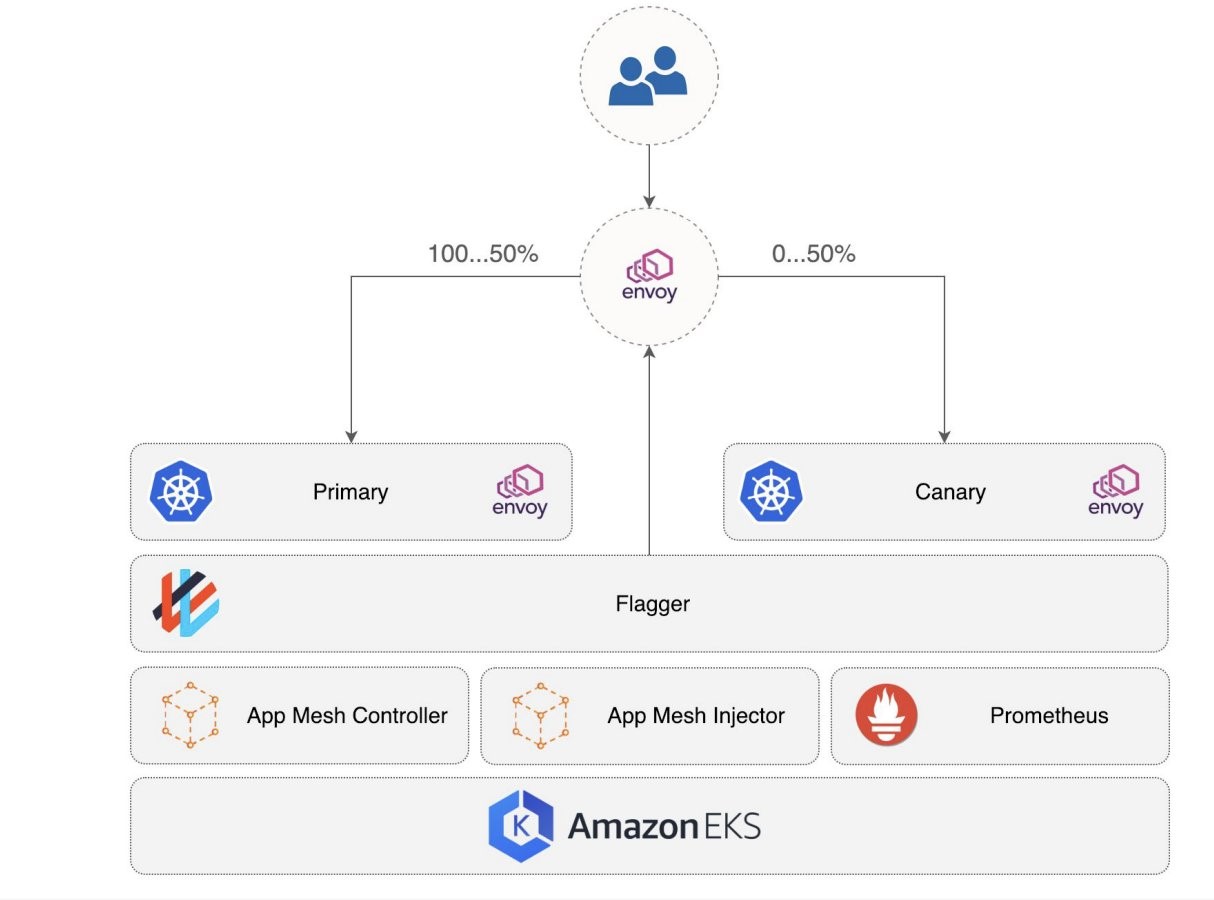
Progressive Delivery using AWS App Mesh and Flagger
NOTICE: October 04, 2024 – This post no longer reflects the best guidance for configuring a service mesh with Amazon EKS and its examples no longer work as shown. Please refer to newer content on Amazon VPC Lattice. ——– In this blog, we will cover how to implement progressive delivery using AWS App Mesh and […]
re:Invent 2021: AWS Containers track
In 2021, re:Invent offers an in-person and virtual conference experience for our attendees. The in-person part of the event will be held in Las Vegas from November 29, 2021 – December 3, 2021. Attendees for the virtual event can register for free and will have access to a subset of the sessions over the virtual […]
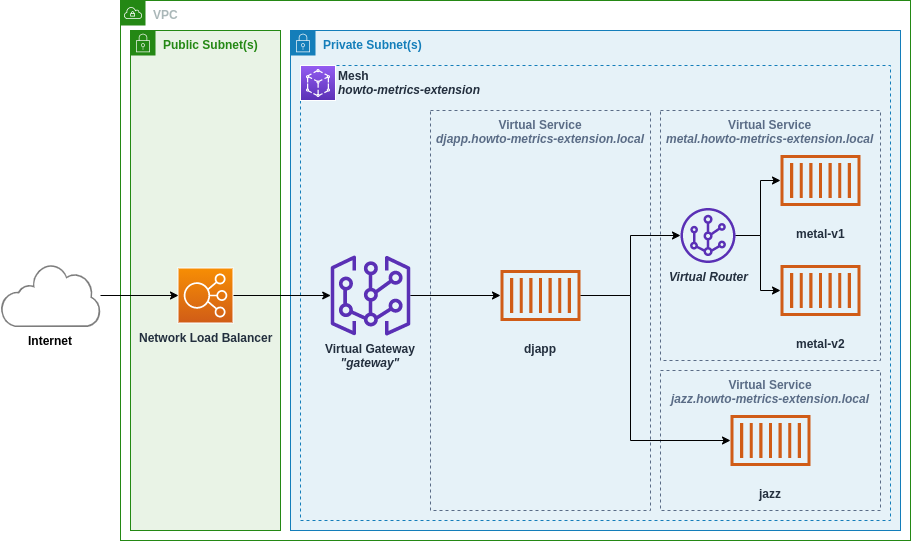
Introducing AWS App Mesh Metrics Extension
NOTICE: October 04, 2024 – This post no longer reflects the best guidance for configuring a service mesh with Amazon ECS and Amazon EKS, and its examples no longer work as shown. For workloads running on Amazon ECS, please refer to newer content on Amazon ECS Service Connect, and for workloads running on Amazon EKS, […]

Enabling mTLS in AWS App Mesh using SPIFFE/SPIRE in a multi-account Amazon EKS environment
NOTICE: October 04, 2024 – This post no longer reflects the best guidance for configuring a service mesh with Amazon ECS and Amazon EKS, and its examples no longer work as shown. For workloads running on Amazon ECS, please refer to newer content on Amazon ECS Service Connect, and for workloads running on Amazon EKS, […]

Red Hat OpenShift Service on AWS: private clusters with AWS PrivateLink
Red Hat OpenShift Service on AWS (ROSA) clusters can be deployed in a few ways, public, private, and private with PrivateLink. Public and private clusters both have the OpenShift cluster accessible to the internet and define whether the application workloads running on OpenShift are private or not. However, there are customers with a requirement for […]